The core competitiveness in the energy storage industry has long transcended mere capacity expansion and price competition; the authority to define industry standards remains the decisive factor in this trillion-dollar sector. Whoever establishes universal standards for next-generation energy storage cells first will secure a dominant market position and control both the industry's development direction and regulatory framework.
Two years ago, China's energy storage industry operated under highly unified standards, with the 314 Ah cell paired with a 5 MWh battery pack being the universally accepted benchmark. However, as third-generation cell technologies advanced rapidly, the sector reached a pivotal transition point where two innovative solutions emerged swiftly, establishing two dominant competitive camps that fundamentally reshaped the traditional energy storage landscape.
✅ Camp 1: 587 Ah wound cells + 6.25 MWh battery compartment
✅ Camp 2: 684 Ah stacked battery cells + 6.9 MWh battery compartment
The two solutions correspond to distinct battery cell technologies and underlying design philosophies, tailored for different market scenarios. Using accessible language, this article provides a thorough analysis of the core advantages, fundamental principles, and applicability boundaries of both approaches, enabling energy storage professionals to accurately grasp future industry trends and technological evolution directions.
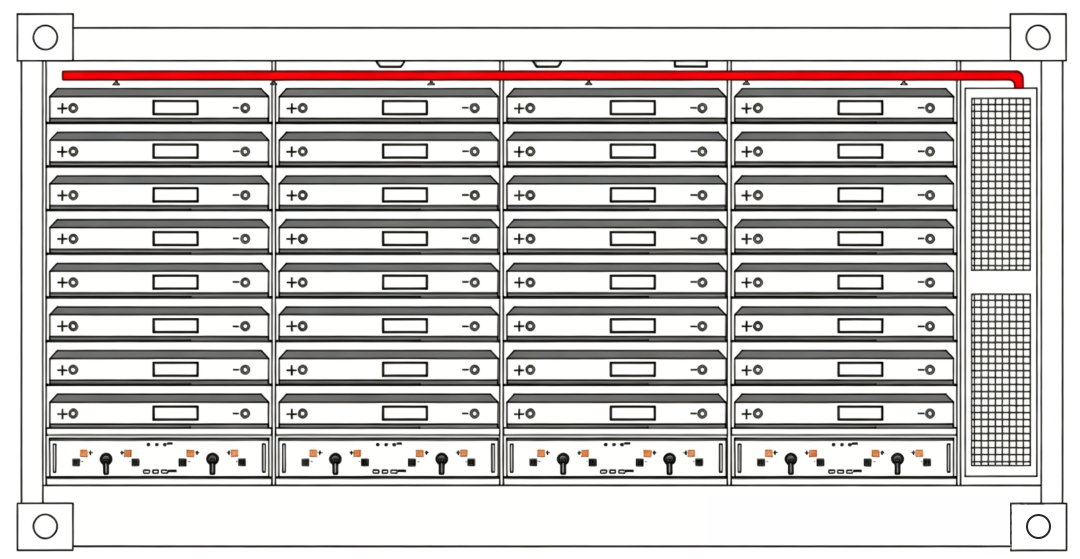
The 587 Ah cell paired with a 6.25 MWh battery compartment solution is designed primarily to comply with China's national energy storage safety standards—a mature approach developed through reverse engineering and refinement based on these requirements. Its key advantages include exceptional regulatory compliance, optimal land utilization, and suitability for large-scale standardized energy storage power station projects.
The latest national standard, "Design Standard for Electrochemical Energy Storage Power Stations" (GB/T 51048-2025), explicitly stipulates that the energy storage capacity of a single unit shall not exceed 50 MWh. If this limit is exceeded, a dedicated fire separation distance of 10 meters must be maintained between all energy storage units.
In the construction of energy storage power stations, land constitutes a core scarce resource. The mandatory 10-meter fire separation distance significantly occupies site space, increases land acquisition and infrastructure costs, and directly reduces investment returns—representing a fundamental challenge to large-scale industry implementation.
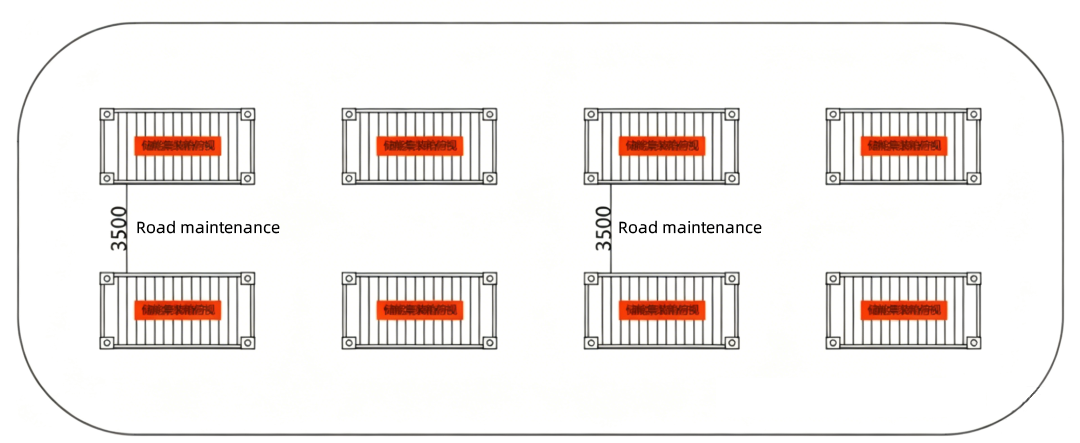
The core principle of this design lies in the optimal numerical ratio: 6.25 MWh × 8 = 50 MWh.
The precisely engineered single-cell capacity of 6.25 MWh enables eight standardized battery modules to be seamlessly assembled into a complete, compliant 50 MWh energy storage system. This configuration perfectly meets the upper limit of national standards without requiring additional fire separation distances, fully eliminating land waste while strictly complying with safety regulations and significantly enhancing both space utilization efficiency and overall construction effectiveness.
Key Summary: The 587 Ah solution represents a quintessential policy-driven optimal design, using national standards as the core benchmark. Through an advanced modular configuration approach, it balances safety compliance, land cost considerations, and large-scale deployment requirements, making it the most versatile standardized energy storage solution available.
Unlike the 587 Ah design that prioritizes compliance, the 684 Ah cell paired with a 6.9 MWh battery compartment adopts a strategy focused on leveraging mature market hardware and optimizing system efficiency. By utilizing standardized components, it achieves a zero-redundancy, highly adaptable, and flexible system architecture, delivering exceptional operational performance.
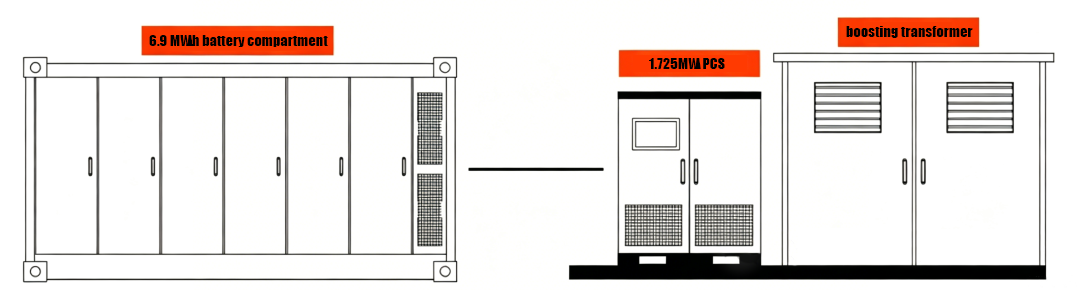
The PCS (Power Conversion System) is the core power component of energy storage power plants, directly determining the system's charging/discharging efficiency and stability. In China's current energy storage market, the 1.725 MW PCS model boasts mature technology, large-scale production capacity, and a well-established supply chain. After years of market validation, it combines low cost with high reliability, making it the industry-standard equipment widely adopted across the sector.
The industry-standard industrial and commercial applications, as well as grid energy storage scenarios, primarily require 4-hour energy storage capacity. Based on standard equipment parameters, the optimal configuration formula is derived as: 1.725 MW × 4 h = 6.9 MWh.
The 6.9 MWh battery compartment and the 1.725 MW Power Conversion System (PCS) achieve precise one-to-one matching, forming a standardized, high-efficiency, redundant-free 4-hour energy storage unit. This configuration completely eliminates issues of power and capacity surplus waste while maximizing hardware performance. Additionally, the modular design allows flexible expansion, making it suitable for both small-to-medium commercial and industrial energy storage projects as well as large-scale grid-connected energy storage facilities, offering exceptional scenario adaptability.
Key Summary: The 684 Ah solution represents a quintessential device-adaptive optimal design, leveraging mature, versatile core hardware to create a standardized energy storage system with low losses and high efficiency. Its key strengths lie in superior system performance and flexible scalability.
The fundamental difference between the two major solutions lies in the direct competition between the two mainstream manufacturing processes for energy storage cells: the stacking process versus the winding process. These structural differences directly determine the cell's performance, safety, production cost, and mass-production capacity, comprehensively impacting the overall efficiency of the power station. The detailed comparison is as follows:
Comparison Dimension | 684 Ah battery cell (stacked-cell manufacturing process) | 587 Ah battery cell (winding process) |
Popular Analogy | Neatly stacked bread slices with a regular structure and no excess gaps. | The elongated electrode sheets are continuously wound and integrally rolled into a core. |
technical principle | The positive and negative electrode sheets are alternately layered and stacked during the molding process. | The elongated electrode sheets are continuously wound and integrally rolled into a core. |
Space Utilization Rate | Highly compact in internal structure, offering greater energy storage capacity for its given volume. | The current transmission path is longer with higher internal resistance, resulting in relatively greater operational heat generation. |
Conductivity and Heat Generation | The current transmission path is short with low internal resistance, featuring high charging/discharging efficiency and minimal heat generation. | The current transmission path is longer with higher internal resistance, resulting in relatively greater operational heat generation. |
Safety Performance | Uniform internal temperature distribution with no stress concentration points, ensuring structural stability and enhanced safety. | The overall performance is mature and stable; however, the C corner represents a stress weak point, posing potential risks under long-term cyclic loading. |
Mass Production and Costs | The equipment requires high initial investment and exhibits relatively low efficiency in early-stage mass production; however, it features rapid technological iteration and significant upgrade potential. | With fully mature production processes, high yield rates, rapid mass production capabilities, and significant cost advantages at scale. |
A simple explanation of the two processes:
▪ 684Ah stacked cell: A technologically advanced solution, akin to a high-end luxury residence, featuring a well-designed internal structure and leading performance, efficiency, and safety. The only drawback is the substantial initial equipment investment and limited mass-production capacity.
▪ 587Ah wound cell: a mature and reliable solution, akin to premium residential housing – its manufacturing process has been rigorously validated by market experience, featuring rapid mass production, high yield rates, and cost control, making it perfectly suited for large-scale industry adoption.
The debate between 587 Ah and 684 Ah standards is far more than a mere comparison of cell capacities—it epitomizes the energy storage industry's transition from extensive growth to high-quality innovation. Behind this rivalry lie three fundamental industry principles:
1. Technical approach dilemma: The choice between mature, low-cost winding processes versus high-performance, high-potential stacking processes represents a dual exploration of "large-scale implementation" and "high-end upgrading" in the industry.
2. Systematic Thinking Framework: A land optimization approach that complies with national standards while reducing costs and improving efficiency versus a system optimization approach focused on equipment adaptation and performance enhancement, both addressing the core requirements of diverse application scenarios.
3. The competition for industry discourse power: The first implemented standardization scheme will reshape the rules governing the entire industrial chain of energy storage cells, battery modules, and integrated systems, shaping the development trajectory of the industry for years to come.
The energy storage industry previously experienced rapid growth through assembly integration and scale expansion, representing a phase of extensive, unregulated development. This ultimate competition over battery cell standards formally marks the industry's transition from chaotic expansion to a new era of high-quality development characterized by meticulous refinement, standardization, and precision.
In reality, there is no absolute superiority between 587 Ah and 684 Ah capacities; the choice depends on specific application scenarios: 587 Ah is ideal for compliance-driven, low-cost, and large-scale deployment scenarios, while 684 Ah suits high-performance, safety-critical, and premium-quality energy storage applications.
For every professional in the energy storage sector, understanding this standardization debate is key to grasping the future dynamics of entry into the trillion-dollar energy storage market. The industry's core competitiveness will ultimately hinge on achieving an optimal balance among cost, efficiency, and safety. Companies that pioneer the establishment of industry-wide standards and deliver the best integration of these three factors will ultimately shape a new paradigm for the energy storage sector.
 How to Source Lithium RV Batteries for OEM and Wholesale ProgramsSeptember 22, 2026Buying an RV battery for personal use is relatively straightforward: the owner knows the vehicle, expected travel pattern and available battery compartment. Sourcing batteries for an RV production lin...view
 Classification and Characteristics of Lithium BatteriesMarch 31, 2026Lithium-ion batteries are characterized by their high energy density, lightweight design, lack of memory effect, and environmental friendliness. They are widely used in electric vehicles, energy stora...view
 Energy Storage Battery Manufacturers in 2026: A Sourcing Checklist for Long-term, Low-risk ProjectsJune 16, 2026The energy storage market is crowded, but quality is not equal — and the gap between a reliable supplier and a problematic one rarely shows up at commissioning. It shows up six to twelve months later...view
 Celebrating 2 Years: JREPower Indonesia Production Base AnniversaryJanuary 13, 2026Today, JREPower (Shenzhen JREPower Tech Co., Ltd.) grandly celebrated the 2nd anniversary of its production base establishment in Jakarta, Indonesia. The milestone event gathered local government...view
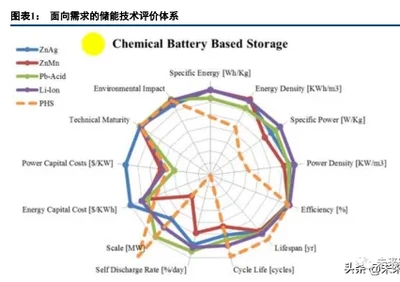 Deep Report on Lithium Battery Industry: A Collection of Battery Technology ProspectsJanuary 13, 2026Energy storage technology is fundamentally a technology that caters to demand, and its evaluation indicator system encompasses energy indicators, power indicators, scale indicators, lifespan indicators, ...view
 Easy to Understand! Complete Guide to Distinguishing Primary and Secondary Equipment in Substations The Doers vs. The Managers — Mastering Substation EquipmentJuly 22, 2026A substation is the core hub of a power system—a critical node for transmitting, converting, and distributing electrical energy. For many newly hired electricians and power industry newcomers, the mo...view
 EN
EN
 ru
ru